Actun Tunichil Muknal is Mopan Maya, and it translates almost literally: actun for cave, tunich for stone, muknal for burial place. Say it out loud as ahk-TOON too-NEE-cheel mook-NAHL and you are already closer to the site than half the visitors who book it as “the ATM cave” and assume they are getting a wet scramble with pretty rocks.
Here is the thing most listings skate over. This is a ceremonial site that happens to accept visitors, not a visitor attraction that happens to contain old things. Everything below is the story of who came, what they carried in, and what they left behind. The 6:30 a.m. pickups, the BZ$60 permit and the sodden shoes live elsewhere, on the transport and tickets pages.
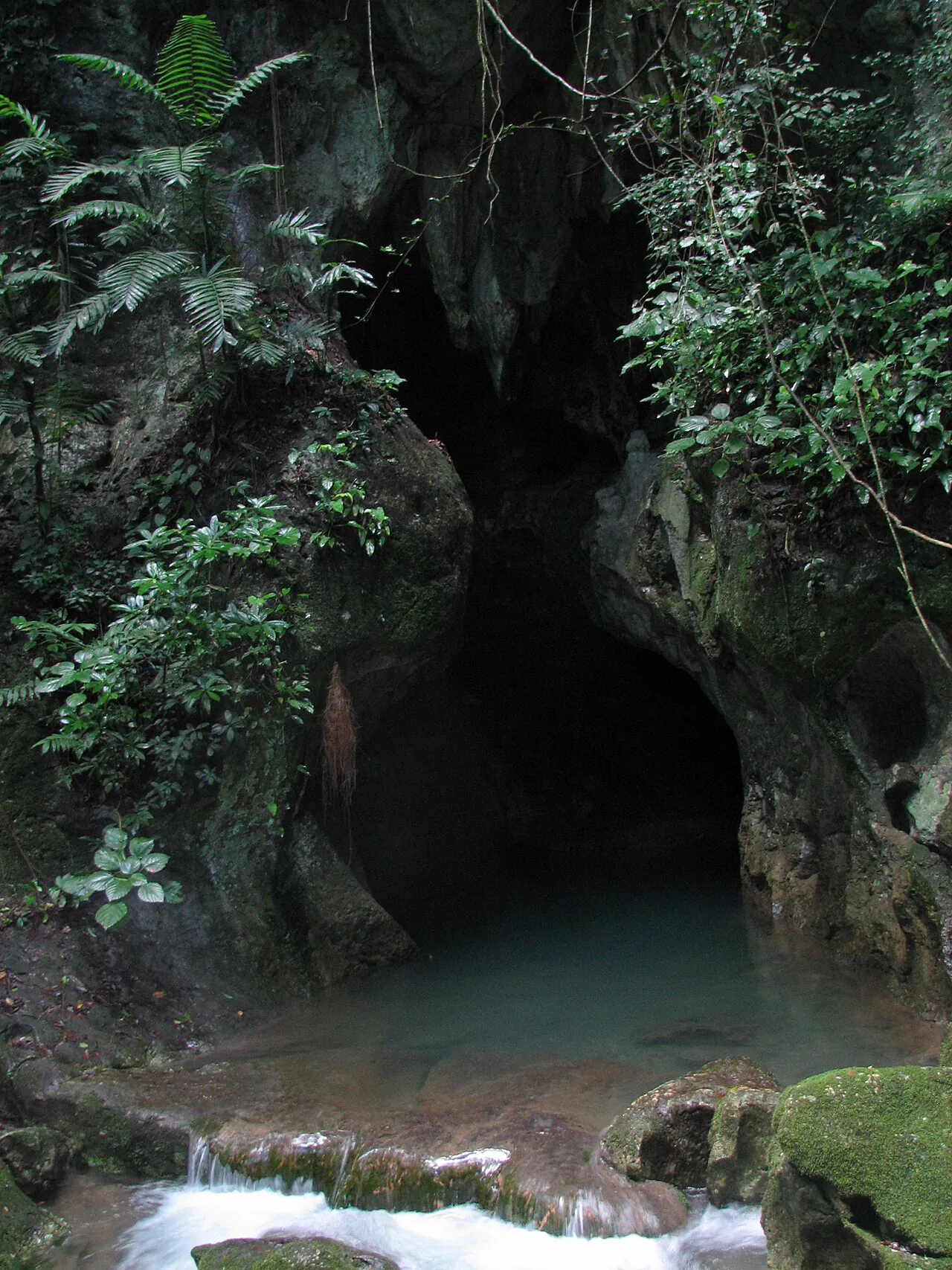
The Cave of the Stone Sepulchre
Six years of living in San Ignacio and I still get a small jolt when the entrance comes into view. Not fear. More the sense of standing at a door that was never really meant for me.
Maya peoples across the Cayo District used caves as the opposite of a house: not a place to shelter, but a place to negotiate. Rain, maize, fertility, the goodwill of the gods who lived below the surface. Actun Tunichil Muknal was one of those negotiating rooms, and it stayed in use for centuries. The archaeology inside is not a scattered accident. It is a sequence of deliberate deposits, some of them metres from where they were set down more than a thousand years ago.
What you walk into, then, is a sealed ceremonial record. There are no glass cases and no ropes, which is both the privilege and the problem.
Sacred Karst: How River Waters Shaped the Realm
The Wet Half
The whole system runs about 4.8 km through Cretaceous limestone, and roughly 3.2 km of that is active river passage. Slightly acidic water has been chewing this rock apart for an unthinkably long time, dissolving fractures into tunnels, tunnels into chambers. You swim the first stretch. Later you wade it. On a high-water day it wades you.
The Dry Half
The upper galleries add another 1.6 km or so, and the river never reaches them. This is where the ritual happened, and it is where the air turns still and mineral. Everything up there is coated, cemented, held in place by calcite. That is precisely why the artefacts survived, and precisely why a single careless footstep is permanent damage.
Guides will tell you that visitors see maybe a kilometre and a half of the whole thing. The rest stays closed, unsurveyed by tourists, quietly dripping.
Xibalba and Chac: Portals to the Maya Underworld
In Maya cosmology, caves were not geological features. They were openings. Xibalba (shee-BAHL-bah), the underworld, sat beneath the surface, and a cave mouth was one of the few places where the two worlds touched. Water made a cave doubly powerful, because water itself was sacred and scarce in the Yucatán and much of the Maya lowlands. Chac, the rain god, was petitioned at exactly this kind of address.
Not many visitors realise how firmly the “nobody lived here” rule applies. People did not raise families inside Actun Tunichil Muknal. They did not cook dinner or sleep in it. The ceramics are almost all serving vessels and storage jars, not the everyday domestic clutter of a household. It was a place you entered with purpose, and left.
“When we go in, we take our helmets off at the dry line and we lower our voices. Not because the tourists expect it. Because my grandfather’s people would have.” My guide, on his four-hundredth-odd descent.
From the Light into the Deep: Chronology of Ritual Offerings
The earliest activity clusters near the Upper Entrance Chamber, in the zone that still catches daylight. From roughly A.D. 250 to 600, people brought agricultural offerings and ceramics to that threshold area, and at least one adult was buried there. Modest, accessible, close to the world of the living.
Then something changed. Somewhere in the Late to Terminal Classic, between about A.D. 700 and 909, the ritual moved roughly a kilometre upstream into the dark. That is a long, awkward, torch-lit journey with pots on your back. Archaeologists link the shift to a run of severe, multi-decade drought and the political unravelling of the Classic Maya centres. When the rain fails, you go further in and ask harder.
Worth saying plainly: this is interpretation, not certainty. The dating is solid; the motive is a reasoned argument. Good guides present it that way.
| Period | Approximate Dates | Location in the Cave | What Was Deposited |
|---|---|---|---|
| Early Classic | A.D. 250–600 | Upper Entrance Chamber, near daylight | Agricultural offerings, ceramics, one adult burial |
| Late Classic | A.D. 700–900 | Around 1 km upstream, dry galleries | Bulk of the ceramic assemblage, slate stelae, obsidian blades |
| Terminal Classic | to A.D. 909 | Deepest chambers and alcoves | Human remains, including the individual known as the Crystal Maiden |
Vessels with Souls: 1,400 Pots and Ritual Kill Holes
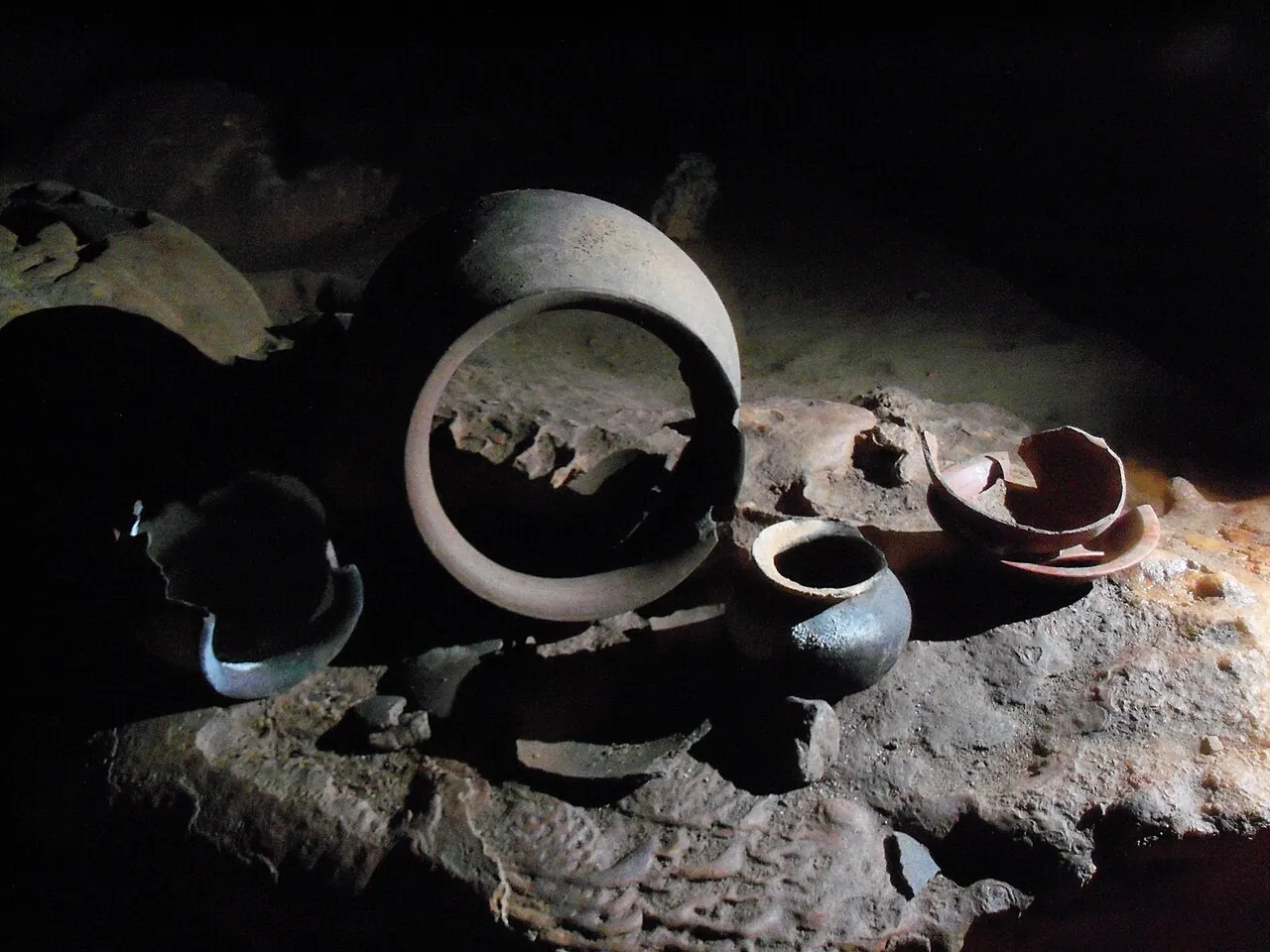
Roughly 1,400 ceramic vessels have been recorded inside. Many were deliberately pierced or smashed before deposition, and the holes are usually described as “kill holes.” The logic is not vandalism. In Maya thought, a pot was a living thing with a soul, and “killing” it released that essence so the object could travel into the otherworld alongside the offering. The same principle shows up in Maya burial practice and in the treatment of carved monuments.
Almost nothing has been reconstructed or lifted out. That is the point. The vessels sit where they were set down, half-merged with flowstone, some with their original contents still sealed inside. A pot on a museum shelf tells you what a pot looked like. A pot on a cave floor tells you what someone did with it.
Flowstone Altars, Slate Stelae and Bloodletting
In the Stelae Chamber, engraved slate slabs stand upright among natural calcite shelves. Those shelves are not built altars. They are flowstone, formed drip by drip, and the Maya used them as readymade tables for offerings. Obsidian blades have been found nearby, and given how closely bloodletting ties into Maya ritual communication with the divine, it is a reasonable reading that some of those blades drew royal or priestly blood in this room.
The best-known vessel in the assemblage is the Monkey Pot, a large jar decorated with a modelled monkey figure. It has become the shorthand image for the site, and it earns the fuss: a domestic shape carrying a mythic animal, left in a place where neither belonged by accident.
Everyday Objects in a Sacred Place
What surprised me most on my first visit was not the bones. It was the grinding stones.
Manos and metates, the paired stones used to grind maize every single day, were carried deep into the cave and left there. They are heavy. Carrying one through a river and up a wet ladder is a decision, not a slip. Archaeologists read them as evidence that ordinary people, likely women, were among the offerants, bringing the tools of their labour as the offering itself. Hardly anyone mentions this in the tour brochures, and it changes the whole picture of who this cave was for.
The Fourteen: Reading the Human Remains
Fourteen individuals have been recorded. Six were children under three. One was a child of around seven. Seven were adults between roughly 20 and 40 years old. Cranial trauma appears on several of the adult skulls, and the bodies were placed rather than dumped: arranged, sometimes in alcoves, sometimes with artefacts close by.
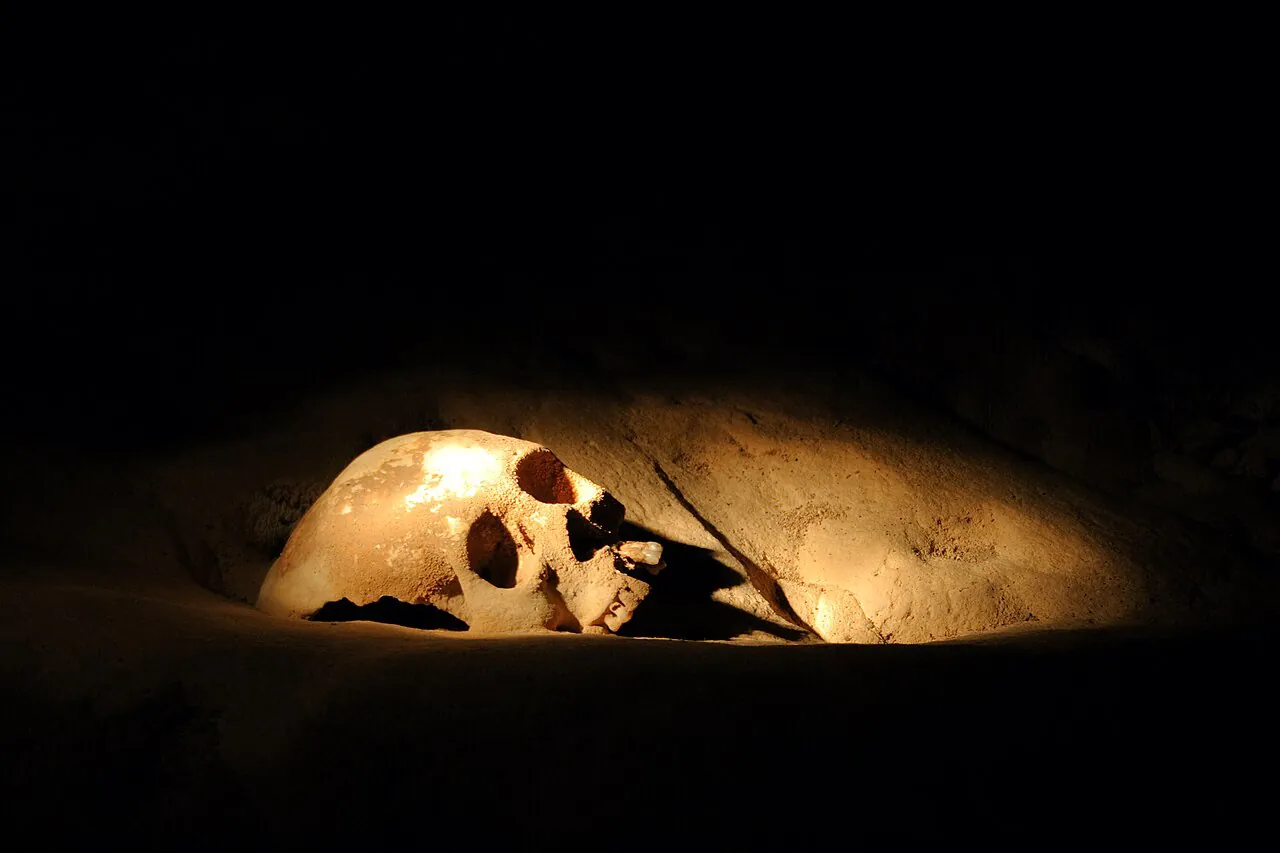
How you describe this matters. “Sacrifice” is the accurate word, and also the word most likely to turn a sacred site into a horror trailer. These were not random victims. The deposits suggest chosen offerings, made in a period of real crisis by people who believed the stakes were everything. My own view, six years in and still a foreigner here: say it quietly, and let the visitors do the arithmetic themselves.
The Crystal Maiden: Individual No. 13
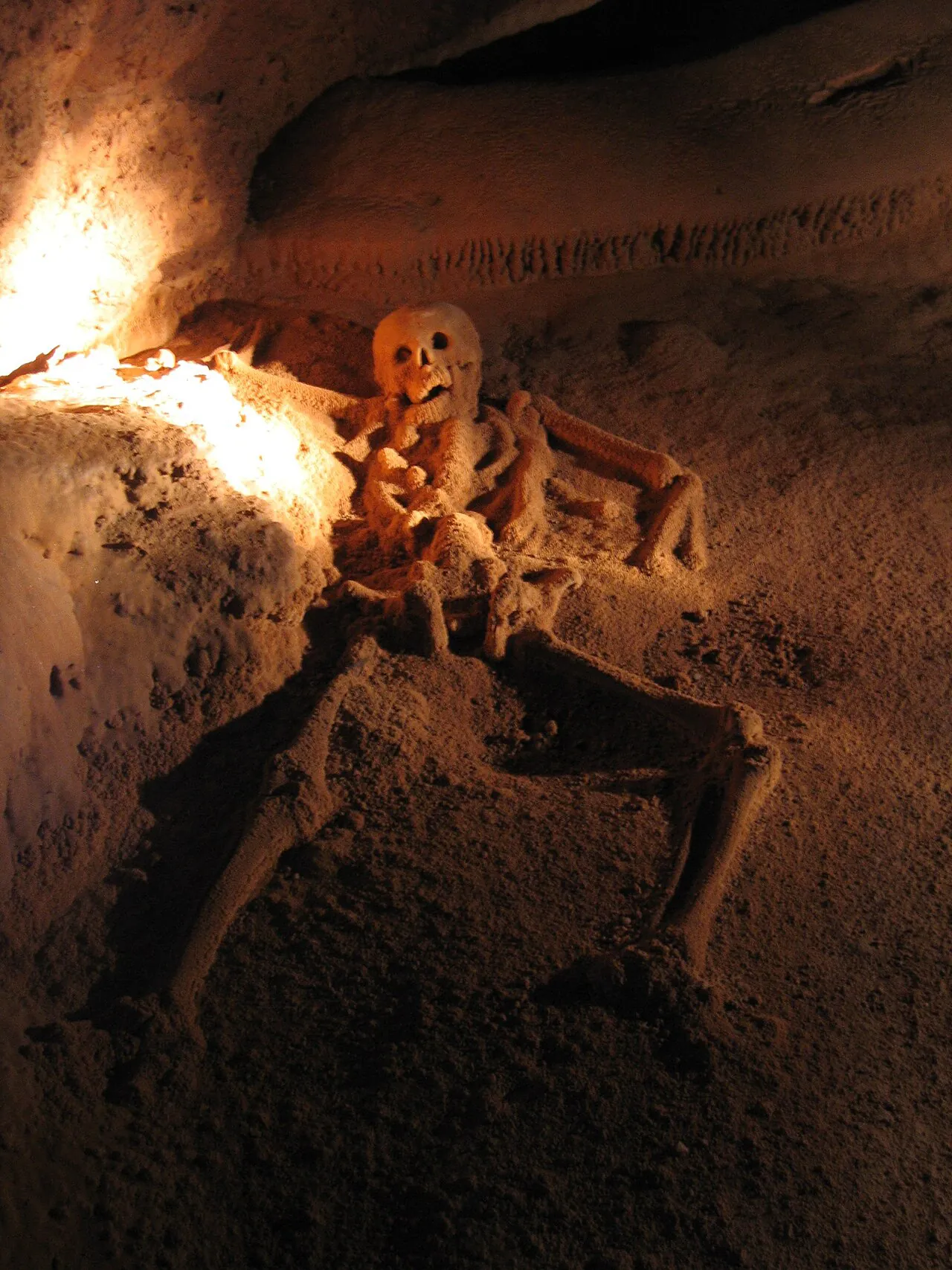
At the far end of the upper gallery, in a small alcove, lies the skeleton everyone comes for. Individual No. 13 has been coated over centuries by calcite-rich drip, so the bone now looks crystalline. Hence “the Crystal Maiden,” a name coined for tourists, not by archaeologists.
The popular version of her story is tidy and grim: a young woman, clubbed and left. The scientific version is messier. Her sex and age at death have been debated, with some osteological assessments questioning the female attribution and the exact age. What is not in doubt is the position of the body, the trauma recorded on the remains, and the fact that she lies exactly where she was placed over a thousand years ago.
Guides still tell the Maiden’s story the popular way, and I have stopped correcting them. A name and a narrative are how most of us hold on to people who died a millennium before we were born.
You view her from a distance, from outside the alcove, usually in a group of six with your helmet off. No approaching, no leaning in, no photographs. It is a genuinely affecting few minutes, and it is over quickly.
Calcite: How the Cave Preserved and Entombed Everything
Water saturated with calcium carbonate drips, evaporates, and leaves mineral behind. Do that for a thousand years and you get a coating thick enough to cement a sherd to the floor and fossilise a skull into the shape of a jewel. The same process that preserved the site also made it impossible to study casually. Every object is effectively glued in place, which is why the excavation strategy had to be so careful and why the in-situ model became policy rather than preference.
The floor of the dry chambers is the fragile part. It looks like rock. Some of it is a crust over archaeology, and it will not grow back.
Discovery, Excavation and the In-Situ Model
Thomas Miller swam into the system in 1989. A British speleological survey followed in 1990, producing a map in 1991 that finally made sense of the passages. Excavation ran from 1993 to 1998 under Jaime Awe and colleagues, and the decision they took has shaped everything since: leave it all in place. No clearing out, no crates to a museum. In 2004 the site was designated a Natural Monument.
That choice is why you can stand in a chamber and see an arrangement rather than a display. It is also why the visitor rules are unusually strict. You can read the full regulatory framework through the National Institute of Culture and History (NICH), the body that issues permits and sets the daily ceiling.
National Geographic and the Sacred-Cave Canon
In 1992, National Geographic filmed Journey Through the Underworld here, and Actun Tunichil Muknal has been in the sacred-cave canon ever since. Later rankings put it at the top of the “sacred cave” lists, and that is roughly when the visitor pressure arrived. A cave that had been a research site became a bucket-list item.
The guides absorbed the consequences. Sixty-two people in the whole country currently hold the specialist ATM licence, and one of them appears in the One Strange Rock series, which tells you something about how seriously the interpretation is taken. A general Belize cave licence does not get you in. If you want the wider regional picture, our piece on the Maya sites of Cayo places this cave among the plazas and stelae it belonged to.
Archaeology Meets Modern Stewardship
The Broken Skull and the Camera Ban
In May 2012, a visitor dropped a camera and fractured a skull that had lain intact for roughly a thousand years. The response was a legal ban on phones, cameras and smartwatches inside the cave. It is not an anti-fun rule. It is the direct consequence of one accident, and it is why your photos must come from official sources or from guides permitted to carry a camera.
The Guides Who Carry the Story
Good interpretation is the real conservation tool. A licensed guide working for the Belize Tourism Board registered operator network will tell you where to put your feet, when to take the helmet off, and why the socks matter. They also hold the story, in three languages, for six visitors at a time, several times a week.
Conservation Ethics and Sacred Etiquette
Right then, the practical side. The rules are strict because the site is unrepeatable, and the penalties are real. Independent entry is illegal, and there is no ticket window at the reserve gate, whatever a hopeful driver may tell you.
- Eight per guide. Groups are capped at eight guests per licensed guide, and the daily ceiling across all operators sits around 125 visitors. Groups of nine or more split across two guides, though you may share a van.
- Socks are mandatory. You remove wet shoes at the top of the ladder and walk the calcified upper chamber in socks only. This is the single most enforced rule, and the most forgotten.
- Nothing in your hands. Only the guide carries a dry bag. No sunscreen or insect repellent on the skin for the wet sections, since chemical runoff attacks the calcite and the artefacts.
- Paperwork. Your full name, date of birth and nationality go to NICH 24 to 48 hours ahead, and you sign the liability release on arrival. Bring the matching photo ID.
- Quiet, and slow. One morning wave only, no afternoon departures. Inside, that means the whole cave is either calm or crowded, and there is very little in between.
The full rule set, including dress code and footwear specifics, is on our visitor rules page. The physical demands are on the difficulty and safety page, which is the honest one about swimming, claustrophobia and when to sit this out.
What You Will and Won’t See
Here is the plain version, because expectations cause most of the disappointment.
- You will see the wet entrance passage, the river crossings, the dry galleries, pottery in place, slate stelae, flowstone shelves, and the Crystal Maiden’s alcove from a set distance.
- You will not see glass cases, ropes, path lighting, or a reconstructed display. There are no bins, no toilets and no benches beyond the trailhead.
- You will not do any touching, any photography, any filming, or any entry into the Maiden’s alcove. Helmets come off in the dry zone and stay off.
- You will not get a solitary experience unless you take an early departure. A 6:30 or 7:00 a.m. pickup puts you ahead of the 8:00 a.m. San Ignacio wave and the queues at the metal ladder.
If you want the walkthrough, chamber by chamber, with the ladder and the squeeze described properly, read inside the cave next. It is the companion piece to this one: same route, different lens.
One last thing, and it is the thing I would want said if this were my ancestors’ cave. The Maya of the Cayo District are not a historical abstraction. They are the people guiding you, farming the valley, and pushing hardest for the visitor cap. Treat the chamber as a church you happened to be let into, keep your hands to yourself, and the next group gets the same thousand-year silence you did.